
Vinyl Windows in Pensacola, FL: The 2026 Homeowner’s Guide to Coastal Durability
- ECWA

- Mar 13
- 15 min read
Your home's exterior faces a relentless assault from salt air and 110 mph winds every single season. If you're still relying on original aluminum frames, you aren't just fighting a losing battle against corrosion; you're likely losing 30% of your home's cooling efficiency through outdated glass. Upgrading to high-performance vinyl windows is no longer just a luxury; it's a necessary shield for anyone living within five miles of the Gulf. It's a common struggle for Pensacola homeowners who want to protect their investment without spending every weekend scrubbing rust or painting frames.
We understand that keeping your property storm-ready while managing rising utility costs is a top priority. This 2026 guide explains how precision-engineered frames meet the strictest Florida building codes while providing a zero-maintenance solution for your coastal lifestyle. You'll discover the technical advantages of impact-resistant glass, the secrets to lowering your monthly energy bills by up to $50, and why local families are choosing these durable upgrades for lasting peace of mind. Let's ensure your home stands strong against the next big one.
Key Takeaways
Learn why modern vinyl windows are the superior choice for Pensacola’s salt-air environment, offering immunity to the corrosion that plagues traditional aluminum frames.
Discover the specific engineering secrets, from multi-chambered frames to fusion-welded corners, that provide the ultimate water-tight integrity for your coastal home.
Navigate the 2026 Florida Building Code for Escambia County by understanding the "Design Pressure" (DP) ratings required to withstand high-velocity wind zones.
Compare the 20-year lifecycle costs of various materials to see why high-performance PVC is the most cost-effective investment for Florida Panhandle homeowners.
Identify the critical credentials to look for when hiring a local expert to ensure your installation is both stress-free and fully hurricane-ready.
Table of Contents Why Vinyl Windows are the Primary Choice for Pensacola Homes Anatomy of a High-Performance Coastal Vinyl Window Vinyl vs. Aluminum vs. Wood: The Pensacola Comparison Selection & Installation: Meeting Florida Building Codes Finding Vetted Vinyl Window Experts in Pensacola
Why Vinyl Windows are the Primary Choice for Pensacola Homes
Vinyl windows represent the pinnacle of modern building science, moving far beyond the basic plastic frames seen in the late 20th century. Today's vinyl windows consist of high-performance polyvinyl chloride (PVC) frames that are precision-engineered for maximum thermal resistance. As we look toward 2026, the industry has shifted to high-impact polymers that incorporate advanced stabilizers to prevent the warping or yellowing common in older materials. For Pensacola homeowners, this evolution means a window that maintains its structural integrity and aesthetic appeal for decades, regardless of the intense Florida sun.
As your Local Guardian, we view window replacement as a strategic move to protect your property value. In the Florida Panhandle, your home's exterior is under constant assault from UV radiation and moisture. Many homeowners are surprised to learn that uPVC or vinyl sash windows now dominate the local market because they offer a level of protection that wood or metal cannot provide. We don't just install glass; we provide a durable shield that stands up to the specific environmental pressures of Pace and the surrounding coastal areas.
The End of Corrosion: Vinyl vs. The Emerald Coast Air
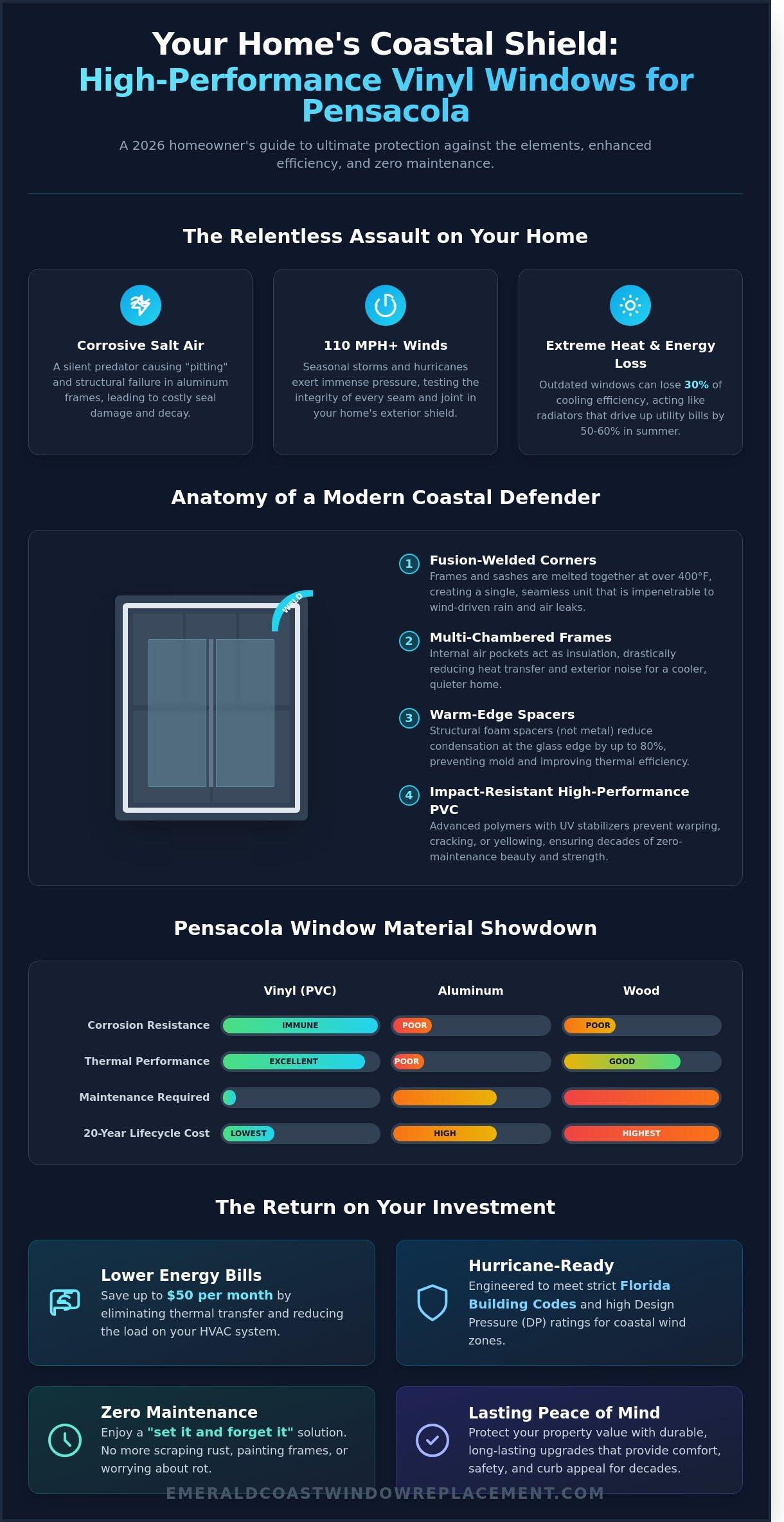
Salt air is a silent predator for homes in Gulf Breeze and Pensacola Beach. While traditional aluminum frames are prone to oxidation, vinyl is naturally immune to the corrosive effects of salt spray. When metal frames are exposed to our coastal atmosphere, they often suffer from "pitting," a destructive process where salt creates microscopic holes and white, chalky residue on the surface. This degradation eventually leads to seal failure and structural weakness. By choosing vinyl windows, you eliminate this risk entirely, saving thousands of dollars in long-term maintenance and premature replacement costs.
Thermal Performance in the Florida Panhandle Heat
Metal is a natural conductor, which is the last thing you want for a window frame during a 95-degree July afternoon in Pace. Aluminum frames act like a radiator, absorbing external heat and transferring it directly into your living space. Vinyl has significantly lower thermal conductivity, acting as a powerful insulator rather than a bridge for heat. This material choice keeps your home's interior surfaces cool to the touch and maintains a consistent indoor climate without forcing your air conditioner to run 24/7.
The financial impact of this thermal efficiency is measurable and immediate. Cooling costs often account for 50% to 60% of a Florida homeowner's monthly utility bill during the peak summer months. By reducing the heat load on your HVAC system, high-quality vinyl frames help extend the life of your cooling equipment while lowering your monthly overhead. We focus on providing solutions that offer a clear return on investment through energy savings and enhanced comfort. Our commitment is to ensure your home remains a sanctuary, even when the Emerald Coast humidity is at its worst.
Modern vinyl frames also utilize multi-chambered designs. These internal air pockets create additional layers of insulation that further block heat transfer and reduce exterior noise. It's a comprehensive approach to home protection that addresses the specific needs of our region. You won't have to worry about the constant upkeep of scraping and painting wood, nor the inevitable decay of metal. It's a stress-free choice for a high-stakes environment.
Anatomy of a High-Performance Coastal Vinyl Window
Modern high-performance vinyl windows are engineered to act as a structural shield for your home. Unlike the thin, hollow frames of the past, today's units rely on precision chemistry and complex internal geometries to survive the Florida Panhandle's volatile climate. One of the most critical features is the use of fusion-welded corners. While economy brands might use screws or brackets that can loosen over time, premium models melt the sash and frame together at temperatures exceeding 400 degrees. This creates a single, airtight unit that refuses to leak even when North Florida rain is driven sideways at 70 miles per hour.
When evaluating different window frame materials, it is clear that vinyl provides a superior thermal break compared to aluminum, which conducts heat rapidly. To combat the 90 percent humidity levels common in Pace, 2026 models now incorporate warm-edge spacers between the glass panes. These spacers are often made of structural foam rather than metal, which reduces condensation at the glass edge by up to 80 percent. This technology prevents the unsightly fogging and mold growth that often plagues older installations.
Multi-Chambered Frames: More Than Just Hollow Plastic
The strength of a vinyl window lies in what you cannot see from the outside. If you were to cut a cross-section of a premium frame, you would find a complex honeycomb of internal air pockets. These chambers serve two vital purposes. First, they trap air to create an insulating barrier that keeps your air conditioning inside. Second, they provide the structural rigidity needed to prevent the frame from warping under the intense July sun.
Chamber Density: While economy windows typically feature only 3 to 5 chambers, premium coastal vinyl windows utilize 12 or more distinct pockets for maximum stability.
Acoustic Insulation: These air pockets also act as a sound buffer. For homeowners living near busy Pensacola thoroughfares like Highway 29 or Avalon Boulevard, these chambers can reduce external noise infiltration by as much as 40 percent.
Thermal Efficiency: Each additional chamber lowers the overall U-factor, directly contributing to lower monthly utility bills during our grueling summer months.
Impact-Resistant Vinyl: The Hurricane Shield
In our region, a window is only as good as its ability to withstand flying debris. Impact-resistant vinyl units integrate a heavy-duty sash with a laminated glass interlayer. This "shatter-but-stay" technology ensures that even if the outer glass cracks upon impact, the inner resin layer remains intact. This prevents the sudden internal pressurization that often leads to roof failure during a major storm event. If you're planning a full home upgrade, you can request a quote to see how these impact ratings affect your insurance premiums.
Structural integrity is further bolstered by the latest 2026 reinforcements. These models now feature internal galvanized steel or carbon-fiber stiffeners hidden within the vinyl chambers. These reinforcements allow the window to handle extreme wind loads without bowing or popping out of the wall. To meet the rigorous safety standards of the Florida Panhandle, every 2026 impact vinyl unit must pass the Large Missile Level D test. This specific certification requires the window to survive being struck by a 9-pound 2x4 timber traveling at 50 feet per second, providing you with absolute peace of mind when the skies turn gray.
Vinyl vs. Aluminum vs. Wood: The Pensacola Comparison
Choosing the right frame material in the Florida Panhandle is a 20-year commitment that dictates your home's safety and your monthly budget. Over a two-decade span, the lifecycle costs of different materials diverge sharply. Aluminum frames often succumb to salt-air oxidation within 12 to 15 years, leading to pitted surfaces and stuck sashes. Wood windows are even more precarious in the high-humidity environments of Milton and Pace. Without meticulous painting every 36 months, wood frames absorb moisture, swell, and eventually rot. High-quality vinyl windows eliminate these risks, providing a stable, non-corrosive solution that maintains its structural integrity from day one through year 20.
A common misconception among Emerald Coast homeowners is that vinyl lacks the strength of aluminum during a hurricane. This is a myth based on outdated 1990s technology. Modern, precision-engineered vinyl frames are built with internal aluminum or steel reinforcements. These units carry Design Pressure (DP) ratings of 50 or higher, which means they are certified to withstand 150 mph winds. They provide the same storm-ready protection as metal frames but without the massive heat transfer that turns aluminum windows into radiators during a July afternoon.
Design options have also evolved. You no longer have to settle for a basic "plastic" look. Current 2026 manufacturing techniques allow for deep architectural colors like bronze, black, and silver, along with realistic wood-grain textures. You can achieve the classic coastal charm of a historic Pensacola home while benefiting from the technological advantages of modern polymers.
The Maintenance Gap: Real-World Time Savings
Maintaining wood windows is a part-time job. For a standard 15-window home in Pace, scraping and repainting frames every four years requires approximately 36 hours of labor. Over 20 years, vinyl windows save you 180 hours of grueling outdoor work. These frames are formulated with high-grade TiO2 (titanium dioxide) to reflect intense UV radiation, preventing the yellowing or brittleness common in cheaper materials. Cleaning is a five-minute task; a simple mixture of mild soap and water removes salt residue and dirt, keeping your curb appeal high with zero specialized chemicals.
Price vs. Value: Why Vinyl Wins in 2026
In the current 2026 market, vinyl remains the most pragmatic investment for Florida homeowners. While custom wood or fiberglass windows can cost 40% to 60% more upfront, they rarely offer a proportional increase in performance or longevity. The financial benefits extend beyond the initial purchase:
Resale ROI: National cost-vs-value reports indicate that homeowners in the Southeast recoup approximately 68% of their investment in window replacement upon selling their home.
Insurance Credits: Under Florida Statute 627.0629, installing impact-rated vinyl units can qualify you for significant windstorm insurance premium discounts.
Energy Savings: Vinyl's superior thermal break can lower cooling costs by as much as 12% compared to non-thermal aluminum frames.
We believe in providing solutions that respect your time and your wallet. By choosing vinyl, you are opting for a "set it and forget it" lifestyle. You get the peace of mind that comes with hurricane-ready glass and the satisfaction of a beautiful home that stays cool, even when the Florida sun is at its most aggressive.
Selection & Installation: Meeting Florida Building Codes
The 2026 Florida Building Code sets a high bar for residential safety. In Escambia County and Pace, these regulations aren't just suggestions; they are legal requirements designed to keep your family safe during a hurricane. When you select new vinyl windows, you must ensure they meet the specific wind load requirements of your street address. The code mandates that every window opening must be protected by impact-rated glass or shutters if you live in a wind-borne debris region. For most of our neighbors in the Florida Panhandle, choosing impact-resistant glass is the most reliable way to secure the home perimeter without the hassle of boarding up every time a storm enters the Gulf.
Low-E glass coatings are another non-negotiable feature for our Southern climate. These microscopic layers of silver or other low-emissivity materials reflect heat back to its source. During a typical Florida summer, this means the blistering heat stays outside while your air conditioner works less. We specifically recommend "soft coat" Low-E for its superior performance in blocking ultraviolet rays that fade your furniture and flooring. Combining these coatings with multi-chambered vinyl frames creates a thermal barrier that stands up to the 90-degree humidity we face for six months of the year.
Understanding Wind-Borne Debris Regions
Local maps define exactly where your home sits in relation to the coast. In Pensacola, homes within one mile of the coast or in areas where wind speeds reach 140 mph or higher must use impact-rated products. For Pace residents in Santa Rosa County, you can check the specific wind zone via the county's GIS mapping tool. We look for a Design Pressure (DP) rating of at least DP50 for coastal homes. This rating means the window has been laboratory tested to withstand 75 pounds of pressure per square foot. That pressure correlates to the force of 140 mph winds, ensuring your home's structural integrity remains intact during a major storm event.
The Role of Energy Star 2026 Standards
Energy efficiency is the second half of the safety equation. The 2026 standards prioritize two metrics: the U-Factor and the Solar Heat Gain Coefficient (SHGC). In our Southern climate, the SHGC is the most critical number. It measures how much solar radiation enters your home. To keep your cooling bills manageable, look for an SHGC of 0.23 or lower. The U-Factor, which measures insulation, should stay below 0.32. You can verify these numbers by checking the National Fenestration Rating Council (NFRC) label on the glass. A compliant unit will feature:
The Energy Star "Southern" zone certification.
An SHGC rating verified for the 2026 climate tier.
Double-pane construction with argon gas fills between the layers.
Professional installation is the only way to guarantee these high-performance vinyl windows actually do their job. If a window isn't shimmed, leveled, and sealed to the manufacturer's exact specifications, the warranty is often voided immediately. More importantly, an improperly installed window can fail at the attachment points during high winds, even if the glass remains intact. We focus on precision-engineered fitment because a window is only as strong as the frame holding it to your house. Don't risk your home's safety with a DIY approach or a general handyman who lacks specialized hurricane-prep experience.
Ready to ensure your home meets the latest safety standards? Request a quote for Florida-proven windows and protect your investment today.
Finding Vetted Vinyl Window Experts in Pensacola
Selecting a contractor in the Florida Panhandle is a high-stakes decision that impacts your home's safety for decades. Emerald Coast Window Authority simplifies this search by connecting you with a curated network of professionals who specialize in high-performance vinyl windows. We eliminate the guesswork by verifying credentials before you ever receive a phone call. Our vetting process ensures every partner understands the 140 mph wind load requirements specific to Santa Rosa County and the surrounding areas.
Florida’s Department of Business and Professional Regulation (DBPR) reported over 2,500 unlicensed activity complaints during the 2022-2023 fiscal year. This statistic underscores the risk of hiring unverified labor. We mandate that every installer in our network maintains active Florida licenses and comprehensive liability insurance. This protection keeps you from being held liable for on-site accidents and ensures your project meets the strict Florida Building Code standards updated in 2023.
When you sit down for a free in-home estimate, come prepared with specific questions to gauge the contractor's expertise. Don't settle for vague promises; ask for concrete data points. A professional should easily provide the following:
License Verification: Ask for their Florida Certified Glass and Glazing Contractor license number.
Performance Metrics: Request the specific U-factor and Solar Heat Gain Coefficient (SHGC) for the window models they propose.
Permit Handling: Confirm they will pull all necessary permits with the Pace or Pensacola building departments.
Workmanship Warranty: Distinguish between the manufacturer’s product warranty and the installer’s labor guarantee.
Why a Local Referral Matters
National big box retailers often rely on rotating crews who travel between states. These installers might lack a deep understanding of the unique environmental stressors in Pace, such as high humidity and salt-air corrosion. Local Pensacola contractors have a vested interest in the community's resilience. They know which vinyl windows perform best against the 80% average humidity levels we experience. Our role is to bridge the gap between homeowners and these dedicated local craftsmen who prioritize coastal durability over quick turnover.
Your Next Steps for a Storm-Ready Home
Moving from the research phase to installation day is a structured process designed to minimize stress. We recommend gathering at least three estimates through our platform to compare lead times and project scopes. In 2024, the average timeline from the initial consultation to the final inspection typically spans 8 to 14 weeks. This duration accounts for the custom manufacturing of your units and the mandatory permit approval process required by local municipalities.
Once you select a partner, the transition to installation day is seamless. Professional crews often complete the physical replacement in just 1 to 2 days, depending on the number of openings. Quality windows represent more than just a home improvement project; they are a long-term investment in your family's peace of mind. By choosing a vetted expert, you ensure that your home remains a safe, energy-efficient sanctuary against the unpredictable Gulf Coast weather. Take the first step today by requesting a quote from a professional who views your home's protection as their top priority.
Secure Your Coastal Legacy with 2026-Ready Protection
Investing in vinyl windows isn't just a home improvement project; it's a strategic move to safeguard your property against the Florida Panhandle's 150 mph wind zones and corrosive salt air. By 2026, homeowners who prioritize high-performance vinyl over outdated aluminum frames will see significant gains in energy efficiency. Units featuring a 0.27 U-factor provide the thermal barrier necessary to meet updated energy standards, often reducing cooling costs by 31% during the humid summer months. Our guide confirms that modern impact-resistant glass exceeds the current Florida Building Code requirements, ensuring your family stays safe during the next major storm cycle.
You don't have to navigate these technical requirements alone. We connect you with vetted local contractors who specialize in hurricane-impact installations and understand the unique demands of the Emerald Coast lifestyle. Our no-pressure advisory service provides the clarity you need to make an informed decision for your home's long-term value. Get Your Free Pensacola Window Replacement Estimate today to begin your upgrade.
Your peace of mind starts with a home that's built to last. We're here to help you protect it.
Frequently Asked Questions
Do vinyl windows warp in the intense Florida sun?
High-quality vinyl windows engineered for the Florida Panhandle won't warp because they contain stabilizers like titanium dioxide. These frames withstand heat up to 165 degrees Fahrenheit without distorting. In Pace, where summer temperatures regularly hit 95 degrees, this thermal resistance is vital. We use precision-engineered frames that maintain their shape for 20 years or more. This ensures your home stays sealed against humidity and high energy costs.
Are vinyl windows impact-rated for Category 4 hurricanes?
Yes, our impact-rated vinyl windows are certified to withstand Category 4 hurricane winds reaching 150 miles per hour. These units meet the rigorous ASTM E1996 standards for large missile impact. They feature reinforced frames and laminated glass that stays intact even if struck by flying debris. This protection offers peace of mind during the Atlantic hurricane season. It also helps homeowners in Santa Rosa County lower their annual insurance premiums by 12% to 15%.
How much do vinyl windows cost in Pensacola, FL?
Homeowners in Pensacola typically pay between $650 and $1,300 per window for a professional replacement project. This price includes the unit, local permits, and expert installation. Impact-resistant models designed for coastal safety usually start at $950 per opening. While initial costs vary based on size, the 25% reduction in monthly cooling bills quickly pays for the investment. We provide a Free Estimate to give you an exact figure for your specific home layout.
How long do vinyl windows last in a coastal environment?
You can expect your windows to last between 20 and 30 years in our coastal environment. Unlike wood or aluminum, vinyl doesn't rot or corrode when exposed to the salt air of the Emerald Coast. We install units with a 20-year warranty on glass seals and a lifetime warranty on frames. This durability makes them a superior choice for Pace residents. They provide a high-end look that doesn't fade after a decade of sun exposure.
Can I install vinyl windows myself to save money?
We don't recommend DIY installation because a single mistake can void your lifetime warranty and fail Florida's strict building codes. Professional installers ensure the window is perfectly level and square within the opening. This precision prevents air leaks that can increase energy bills by 15% annually. In Pace, windows must meet specific DP ratings to pass inspection. Our team handles 100% of the permitting process to ensure your home remains fully compliant.
What is the difference between single-hung and double-hung vinyl windows?
The main difference is that single-hung windows have one moving sash, while double-hung windows allow both the top and bottom sashes to move. Double-hung models offer 50% more airflow because you can open the top sash to let hot air escape. They also feature tilt-in sashes that make cleaning the exterior glass easy from inside your home. Single-hung units are often 10% to 20% more affordable. Both styles provide excellent energy efficiency for Florida homes.
Do new vinyl windows qualify for energy tax credits in 2026?
Yes, you can claim a tax credit of up to $600 per year for windows that meet Energy Star Most Efficient requirements through 2032. This federal incentive covers 30% of the project's material costs under the Inflation Reduction Act. To qualify, the units must meet specific U-factor ratings of 0.20 or lower. We provide the necessary documentation with every installation to make your tax filing simple. This credit effectively lowers the total cost of your home upgrade.
How do I clean salt spray off my vinyl windows?
You should clean salt spray off your windows every three months using a solution of one gallon of water and two tablespoons of mild detergent. Avoid using abrasive scrubbers or high-pressure power washers that can damage the seals. A soft microfiber cloth works best to remove salt crystals without scratching the glass. Rinsing the frames with a garden hose twice a year prevents buildup. This simple maintenance routine keeps your coastal views clear and protects your investment.


Comments