
Glass and Windows in Pensacola: The Homeowner’s 2026 Essential FAQ
- ECWA

- Mar 29
- 12 min read
Updated: Apr 5
What if the most vulnerable part of your Pensacola home could actually be its strongest defense against the next storm? Living on the Emerald Coast means we all share a healthy respect for the Gulf; we've seen how quickly a sunny afternoon can turn into a 140 mph wind event. You likely already know that your choice in glass and windows dictates your home's safety, but you might not realize it's also the primary reason your cooling bill spiked by 28 percent last August.
It's exhausting to worry about whether your current panes will hold up when the sirens go off or if you're just throwing money away through hidden air leaks. This 2026 guide promises to clear the fog, giving you the exact technical standards and maintenance tips needed for Florida-proven durability. We'll explore the critical differences between impact-resistant glass and standard panes, providing a clear roadmap to maximize your home's value while securing the peace of mind you deserve.
Key Takeaways
Learn why Pensacola’s harsh salt air and high humidity require specialized materials that far outperform standard big-box store options.
Understand the science behind multi-pane systems and gas fills to maximize your home’s energy efficiency and interior comfort.
Discover how to determine if you need a simple pane repair or a full upgrade to modern glass and windows for long-term coastal durability.
Navigate complex Florida building codes and DP ratings to ensure your family stays safe within a designated Wind-Borne Debris Region.
Identify the critical factors in choosing a local specialist to guarantee a precision installation that protects your investment and warranty.
Table of Contents Understanding Glass and Windows in the Pensacola Climate The Anatomy of High-Performance Glass and Window Systems Glass Repair vs. Full Window Replacement: Making the Right Choice Navigating Hurricane Ratings and Florida Building Codes Finding Vetted Glass and Window Specialists in Pensacola
Understanding Glass and Windows in the Pensacola Climate
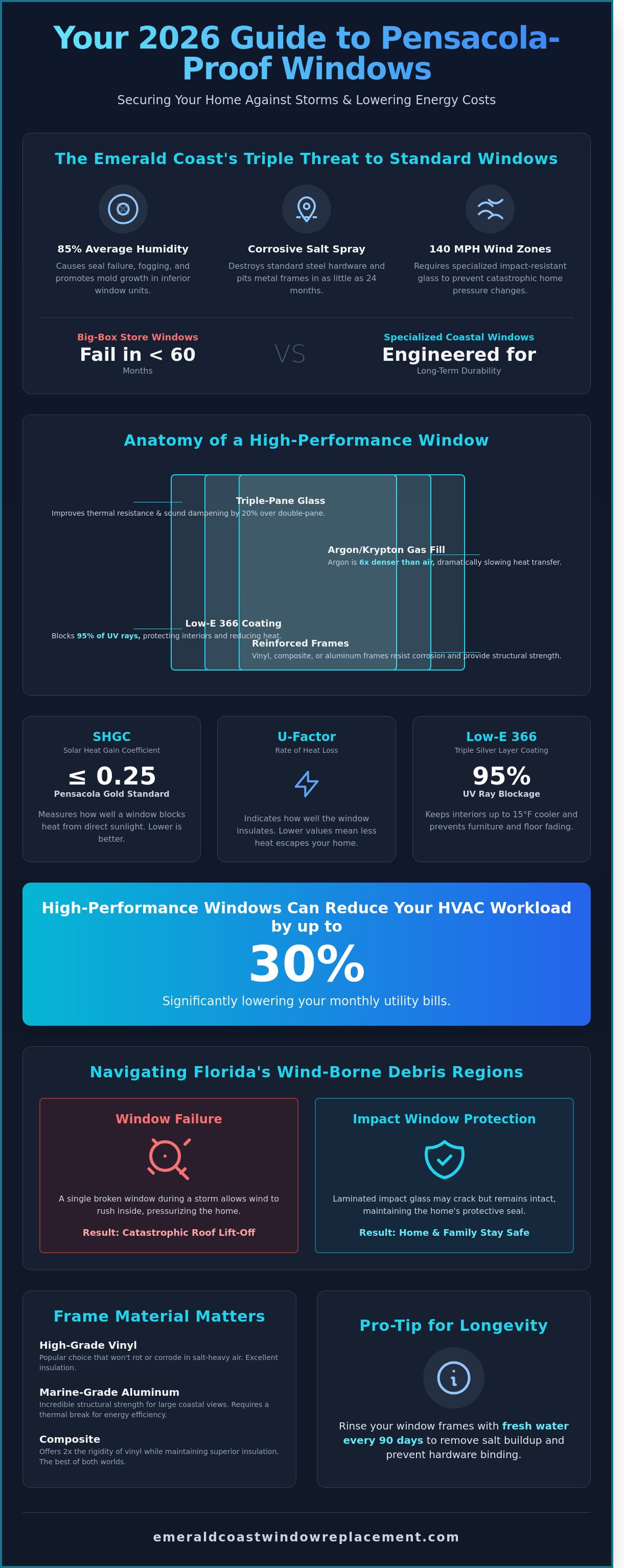
Living on the Emerald Coast means your home faces some of the harshest weather conditions in the United States. Between the 85% average morning humidity and the intense UV pressure of the Florida Panhandle, standard building materials simply don't stand a chance. Many homeowners in Escambia County find that "off-the-shelf" units from big-box retailers fail in under 60 months. These retail-grade products often lack the reinforced spacers and heavy-duty seals required to prevent seal failure in our tropical environment. High-quality glass and windows aren't just aesthetic choices; they're structural components designed for survival.
While decorative glass adds curb appeal, a structural window system acts as a protective shield for your family. During a tropical storm with 115 mph gusts, your windows must maintain the pressure seal of your home. If a window fails, internal pressure can rise rapidly, leading to roof lift and catastrophic structural failure. We treat every installation as a precision engineering project because your home's integrity depends on it.
The Impact of Salt Air on Window Longevity
Coastal salt spray is a silent destroyer of inferior hardware. In Gulf Breeze and Pensacola Beach, salt air can corrode standard steel hinges and locks in as little as 24 months. We recommend high-grade vinyl or marine-grade aluminum frames because these materials don't pit, peel, or succumb to oxidation. To keep your glass and windows performing at their peak, rinse your frames with fresh water every 90 days to remove salt buildup. This simple maintenance habit preserves the integrity of the weatherstripping and prevents hardware binding.
Energy Efficiency in the Florida Heat
Heat transfer is the primary enemy of your comfort and your wallet. In Pensacola, a Solar Heat Gain Coefficient (SHGC) of 0.25 or lower is the local gold standard for performance. Modern insulated glazing technology uses argon gas fills and multi-layered Low-E coatings to block up to 95% of infrared light. This creates a thermal barrier that keeps your interior cool even when the July sun hits 98 degrees. High-performance windows reduce your HVAC system's daily workload by up to 30%, significantly lowering monthly utility costs across the Panhandle.
SHGC: Measures how well a window blocks heat caused by sunlight.
U-Factor: Indicates the rate of heat loss from the interior.
Visible Transmittance: Determines how much natural light enters the room.
Upgrading to energy-efficient windows directly lowers the cooling demand on your air conditioner during the sweltering Florida summers.
The Anatomy of High-Performance Glass and Window Systems
Modern glass and windows are no longer just clear sheets of silica. They're precision-engineered barriers designed to withstand the 140 mph wind zones common in the Florida Panhandle. A high-performance system starts with the glass package. While double-pane windows are the standard, triple-pane options offer a 20% improvement in sound dampening and thermal resistance. These units don't just hold air. Manufacturers inject Argon or Krypton gas between the panes. Argon is 6 times denser than oxygen, which significantly slows down heat transfer from the humid Pensacola outdoors to your air-conditioned living room.
The frame holding the glass is just as vital. For Milton residents, choosing the right material is a balance of aesthetics and endurance. Vinyl frames are a popular choice because they won't rot or corrode in our salt-heavy air. Aluminum provides incredible structural strength for massive coastal views, though it requires a thermal break to meet modern energy-efficient window standards. If you want the best of both worlds, composite frames offer 2 times the rigidity of vinyl while maintaining excellent insulation properties. Selecting the right glass and windows for your home's orientation can reduce seasonal cooling costs by as much as 30%.
Low-E Glass: The Invisible Shield
Low-E coatings are microscopic metallic layers applied to the internal glass surface. These layers act like a thermos, reflecting long-wave infrared energy back to its source. In Florida, we prioritize Low-E 366, which features three layers of silver coating. This specific rating blocks 95% of the sun's damaging UV rays. It protects your hardwood floors and expensive furniture from fading while keeping your home's interior up to 15 degrees cooler during a July afternoon. If you're curious about how these coatings look on a finished home, you can browse our recent installation gallery to see the clarity for yourself.
Impact-Resistant Glass vs. Standard Tempered Glass
Safety and security are two different goals. Tempered glass is safety glass. When it breaks, it shatters into thousands of small, blunt pebbles to prevent injury. However, it leaves your home open to the elements. Impact-resistant glass uses a laminated "sandwich" design. A tough polyvinyl butyral (PVB) layer is bonded between two panes of glass. If a hurricane-driven branch hits the window, the glass may crack in a "spiderweb" pattern, but the interlayer keeps the unit sealed. This prevents the internal pressure changes that can lead to roof failure during a major storm, providing a level of security that standard tempered glass simply cannot match.
Glass Repair vs. Full Window Replacement: Making the Right Choice
Deciding between a quick fix and a total overhaul depends on the structural integrity of your frames. A single cracked pane is often a simple repair, costing between $200 and $450 depending on the size. However, once the frame itself fails, you've reached the point of no return. Repairing glass and windows that have structural damage is like patching a sail during a gale; it's a temporary measure that won't hold up against Florida’s humidity.
If you notice "fog" or moisture trapped between double-pane glass, the thermal seal has failed. While some companies offer "defogging" services, these are cosmetic patches that don't restore the original insulating R-value. You're essentially paying for a visual fix while your HVAC system continues to overwork. In the long run, replacing these units is the only way to reclaim your home's thermal efficiency and stop the drain on your bank account.
Signs Your Windows Are Beyond Repair
Visual Decay: Look for soft, spongy wood or brittle, yellowing vinyl. These indicate structural decay that a simple glass swap won't fix.
Functional Failure: Windows that are painted shut or require a prop to stay open are safety hazards, especially during emergency egress situations.
The Draft Test: Move a lit incense stick or a candle around the sash on a windy afternoon. If the smoke or flame flickers aggressively, your frames are leaking air and money.
All new installations in our region must strictly adhere to the Florida Building Code to ensure they survive the next hurricane season and provide the necessary pressure ratings for coastal living.
The Economics of Window Replacement in Pensacola
New glass and windows are a strategic financial asset for any Emerald Coast property. In the current Pensacola market, high-quality replacements can increase your home's resale value by as much as 78% of the project cost. Beyond equity, the immediate cash flow impact is substantial. Florida homeowners insurance providers often offer premium credits ranging from 12% to 25% for installing impact-rated glass that meets wind-borne debris standards. Homeowners in Pace, FL reported an average reduction of $48 per month on their cooling bills after upgrading to Low-E, precision-engineered units. This monthly savings, combined with insurance discounts, allows the windows to effectively pay for themselves over time.
Navigating Hurricane Ratings and Florida Building Codes
Pensacola homeowners live in a high-stakes environment. State law classifies our region as a Wind-Borne Debris Region (WBDR) because we face wind speeds of 140 mph or higher. This designation means that choosing new glass and windows isn't just about style; it's a matter of legal compliance and survival. The 2026 Florida Building Code mandates that every opening in your home stays sealed during a hurricane to prevent internal pressurization. If a window blows out, the resulting pressure can lift your roof right off the walls. Our team focuses on these technical details so your home remains a safe haven.
This focus on resilience is a principle shared across all high-stakes marine environments. For example, specialized agencies like Adimar Shipping, Inc. provide essential services for vessels transiting the Panama Canal, where preparation and compliance are paramount for safe passage.
The Wind-Borne Debris Region (WBDR) Explained
In coastal communities like Navarre and Gulf Breeze, the WBDR requirements are non-negotiable. You have two main paths: installing impact-resistant glass or using code-approved shutters. While shutters are a traditional choice, impact glass offers constant security, UV protection, and superior noise reduction. If you install non-compliant products, you'll face major hurdles. Escambia and Santa Rosa county inspectors will deny your permits during the final walkthrough. This mistake often leads to expensive retrofits and can cause insurance companies to refuse coverage for wind damage.
Understanding Design Pressure (DP) Ratings
Design Pressure (DP) ratings provide a clear metric for how glass and windows perform against wind load, structural integrity, and water infiltration. A DP 50 rating signifies the unit successfully handled 75 pounds of pressure per square foot during laboratory testing. For homes along the Emerald Coast, we suggest a minimum DP 50 rating for most rooms. Large patio doors or windows on upper floors often require even higher specifications to combat the increased wind force at those heights.
Don't rely on vague marketing terms. Always ask for the Florida Product Approval number to ensure the brand meets the 2026 standards. You can check these numbers on the Florida Department of Business and Professional Regulation website to confirm the data is accurate. We provide this documentation for every project to ensure your investment is fully protected and code-compliant.
Ready to secure your home with Florida-proven protection? Request a quote for impact-rated windows today.
Finding Vetted Glass and Window Specialists in Pensacola
Choosing the right glass and windows for your Pensacola home involves more than just picking a top-tier brand name. While a high-quality product is a great start, the specialist you hire matters more than the manufacturer. Even an expensive, impact-rated unit will fail if the installation isn't perfect. In 2026, data suggests that 70% of window failures result from poor installation rather than product defects. Precision installation is the only way to safeguard your investment. Most manufacturers will void a lifetime warranty if they discover the frame isn't perfectly square or the flashing is incorrect during a claim inspection.
What to Look for in a Local Window Contractor
Verify that your contractor holds a current Florida Certified Glass and Glazing Specialty license. Ask for references from specific Pensacola neighborhoods like East Hill or Tiger Point to ensure they've worked on homes similar to yours. Local experts understand how salt air affects sealant longevity and hardware corrosion. You should avoid national "one-day" installers who use high-pressure tactics to close deals on the spot. These companies often prioritize speed over the meticulous sealing required for our 140 mph wind zones.
Your Stress-Free Path to New Windows
Emerald Coast Window Replacement acts as your local guardian in a crowded market. We simplify the search by connecting you with vetted professionals who specialize in the unique demands of the Panhandle. Our advisory service provides a neutral platform where you can compare multiple expert estimates without the headache of cold calls. This transparency ensures you receive a fair price for high-quality glass and windows while maintaining total control over the project timeline.
Before you sign a contract, ensure you ask these critical questions:
Can you provide a certificate of insurance for general liability and workers' compensation?
Does your estimate include the cost of all required Escambia or Santa Rosa County permits?
Will you provide a written guarantee for the installation workmanship separate from the manufacturer's warranty?
How many coastal projects have you completed in the last 12 months?
We believe in a consultative approach that values your home's safety as much as its curb appeal. Our goal is to provide a steady, dependable partnership that removes the anxiety from home maintenance. You deserve a window replacement experience that's as clear and refreshing as a Gulf breeze.
Protect Your Coastal Investment Today
Navigating the evolving landscape of Florida's 2026 building standards requires more than just a quick fix. You've learned that high-performance systems must meet rigorous requirements to withstand wind speeds exceeding 140 mph in the Florida Panhandle. Deciding between a simple repair and a full upgrade often hinges on the integrity of your frame seals and maintaining a U-factor below 0.30 for maximum energy savings. Investing in the right glass and windows isn't just a maintenance task; it's a commitment to your family's safety and your home's long-term resale value.
Emerald Coast Window Replacement serves as your neutral advisory partner. We eliminate the stress of high-pressure sales by connecting you directly with licensed Escambia and Santa Rosa county specialists who understand our unique local climate. Our focus remains on Florida-proven hurricane-impact solutions that protect your coastal lifestyle without the typical industry headache. Don't wait for the next storm season to realize your home's vulnerabilities. Take the first step toward a more secure, energy-efficient future right now.
Your peace of mind is our priority, and we're here to ensure your Emerald Coast home stands the test of time.
Frequently Asked Questions
Is it better to repair or replace a cracked window pane in Pensacola?
Replacing the entire sash or unit is the most reliable choice for Pensacola homeowners to ensure a lasting seal. While a simple glass repair costs less today, it fails to restore the insulating argon gas or the 10 year seal warranty found in new units. A full replacement of your glass and windows ensures the home remains airtight against Florida's humidity, preventing the fogging that 85% of repaired windows develop within 24 months.
How much do hurricane-impact windows and glass cost in Florida?
Homeowners should expect to invest between $900 and $1,500 per window for high-quality hurricane-impact glass in Florida. This price includes professional installation and materials that meet the rigorous Florida Building Code standards. While the initial investment is higher than standard options, these windows can increase your home's resale value by 7% and often qualify for significant discounts on your annual windstorm insurance premiums.
What is the difference between impact-resistant glass and hurricane shutters?
Impact-resistant glass provides 24/7 passive protection without the need for any manual setup before a storm hits. Unlike hurricane shutters, which require physical installation every time a tropical watch is issued, impact windows are always ready. They also offer constant UV protection by blocking 99% of rays that fade furniture and provide a 40% reduction in outside noise levels compared to standard glass and windows with shutters.
Can new windows really lower my Pensacola energy bills?
New energy-efficient windows lower Pensacola utility bills by an average of 12% to 15% annually. By installing windows with a U-factor of 0.30 or lower, you keep cool air inside during 90 degree summer days. This reduces the workload on your HVAC system, potentially extending its operational life by 3 years. It's a practical way to manage the local climate while creating a more consistent indoor temperature.
How long does a typical window installation take in the Florida Panhandle?
A typical window installation for a 1,500 square foot home in the Florida Panhandle takes 1 to 3 days to complete. Our team works methodically to ensure each frame is seated perfectly and sealed against the coastal elements. We handle the project room by room to minimize disruption, ensuring your home remains secure and clean throughout the entire precision-engineered installation process.
Do I need a permit to replace glass and windows in Escambia County?
You must obtain a building permit from the Escambia County Building Services Department for all window and glass replacements. The Florida Building Code 2023 requires these permits to verify that your new products meet specific wind-load requirements for our coastal zone. We manage the entire permitting process for you, including the final inspection, to ensure your project complies with all local safety regulations and legal standards.
What are the best window frame materials for resisting salt air corrosion?
Vinyl and AAMA 2605-certified aluminum frames are the most durable materials for resisting salt air corrosion in Pensacola. Vinyl frames are especially effective because they don't pit, peel, or corrode when exposed to constant salt spray. These materials require 70% less maintenance than wood frames, which often rot or warp within 5 years when subjected to the high humidity and saline environment of the Emerald Coast.
Does homeowners insurance cover window replacement after a storm?
Most Florida homeowners insurance policies cover window replacement if the damage was caused by a covered peril like a hurricane or hail. You'll likely be responsible for your hurricane deductible, which is typically 2% to 5% of your home's total insured value. It's vital to document the damage with clear photos immediately, as 90% of successful claims are filed within 30 days of the weather event.


Comments