
Energy-Efficient Windows in Pensacola: The 2026 Coastal Homeowner’s Guide
- ECWA

- Mar 10
- 13 min read
Did you know that up to 30% of your home's cooling energy can be lost through inefficient windows, according to the U.S. Department of Energy? For Pensacola homeowners, that's a staggering amount of money vanishing into the humid Gulf Coast air each month. You're right to be frustrated with constantly rising FPL bills and a living room that never seems to stay cool, no matter how hard your air conditioner works. That visible condensation between the panes isn't just an eyesore; it's a sign that your home's first line of defense is failing.
This guide is your solution. We'll show you exactly how choosing the right energy-efficient windows can permanently slash those cooling costs, protect your furniture from harsh UV rays, and increase your home's value. We'll break down the latest Florida-proven technology and materials designed to give you peace of mind. By the end, you'll have a clear roadmap for securing a more comfortable, cost-effective, and protected coastal home for 2026 and beyond.
Key Takeaways
Learn how to interpret key window ratings like U-Factor and SHGC to ensure you choose a product truly built for the Florida Panhandle's climate.
Discover how modern impact-resistant glass provides the dual benefit of hurricane readiness and significant sound dampening for a quieter, more secure home.
Uncover the full financial picture of your window investment, including how to calculate potential utility savings and leverage discounts on your Florida insurance premiums.
Learn the critical questions to ask during a free estimate to ensure your new energy-efficient windows are installed by a professional who understands Pensacola's unique coastal demands.
Table of Contents Why Energy-Efficient Windows are Essential for Pensacola Homes The Anatomy of a High-Performance Coastal Window The Intersection of Hurricane Impact and Energy Efficiency Calculating ROI: Savings, Rebates, and Home Value Choosing the Right Professional in the Florida Panhandle
Why Energy-Efficient Windows are Essential for Pensacola Homes
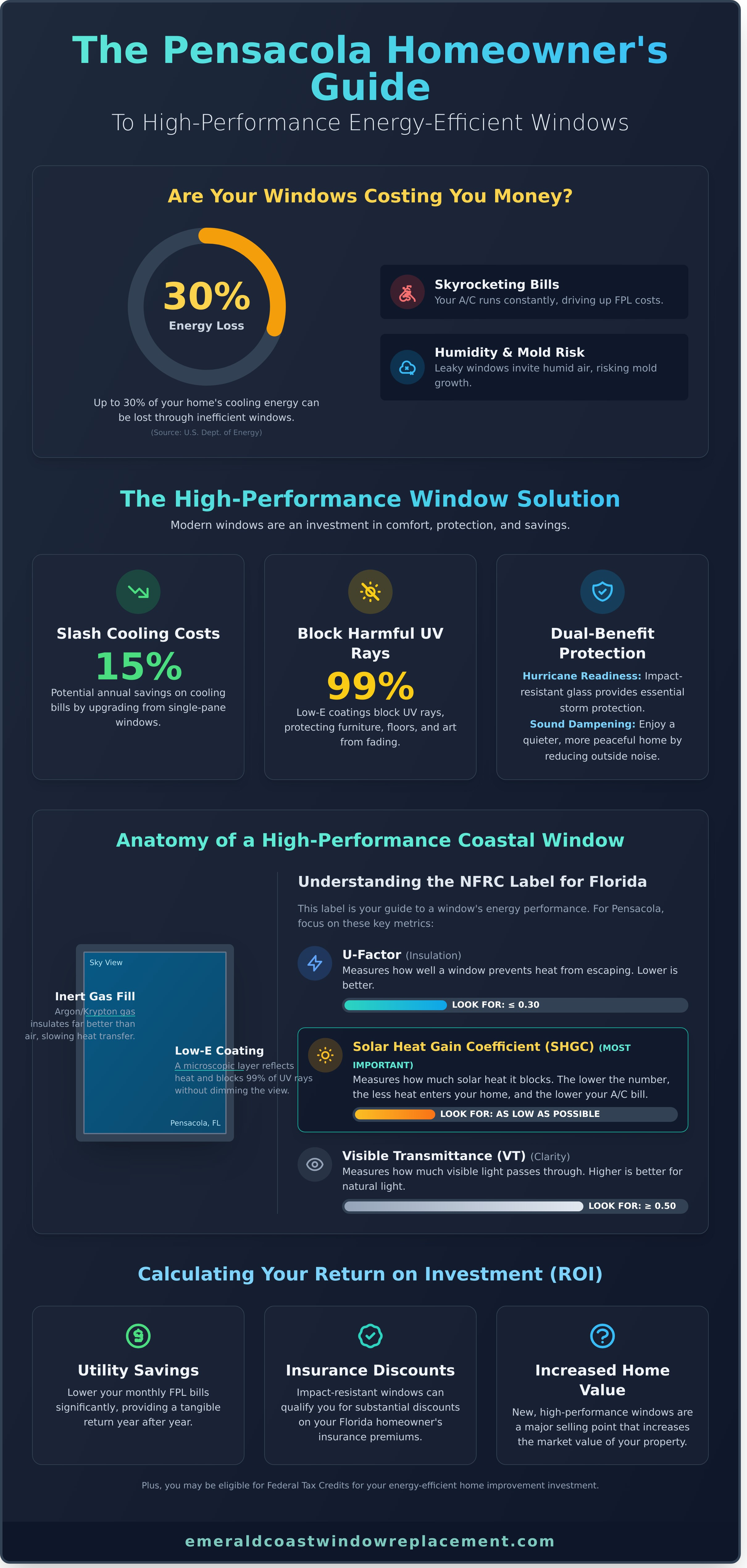
Living on the Emerald Coast means embracing the sun, but it doesn't mean inviting the oppressive heat and humidity into your home. Your windows are the primary gatekeepers of your indoor climate. In fact, according to the U.S. Department of Energy, heat gain and heat loss through windows are responsible for 25% to 30% of residential heating and cooling energy use. In Pensacola's humid subtropical climate, that number almost entirely reflects heat gain. Simply put, energy-efficient windows are precision-engineered systems designed to minimize thermal transfer, block UV radiation, and meet or exceed the stringent performance criteria set by the 2026 NFRC standards. Understanding the anatomy of a high-performance coastal window is the first step toward reclaiming your comfort. The goal isn't just to lower your utility bills; it's to create a consistently cool, dry, and peaceful indoor environment that feels like a private coastal retreat, no matter how high the mercury climbs outside.
The True Cost of 'Leaky' Windows in the Florida Heat
Outdated single-pane or builder-grade windows struggle against the Gulf Coast's climate. During July and August, when average highs consistently push 90°F with intense humidity, these inefficient windows transfer heat directly into your home. This forces your air conditioning system to run almost constantly, dramatically increasing wear and tear while driving up your energy costs. Worse yet, they allow humid air to infiltrate your home, raising the risk of mold and mildew growth, which compromises indoor air quality and can damage your home's structure. Homeowners who upgrade from single-pane windows to modern, high-performance glass can see their cooling costs drop by up to 15% annually, a significant saving that pays for the investment over time.
UV Protection: Saving Your Interiors from the Gulf Coast Sun
The same brilliant sun that makes our beaches famous can be destructive to your home's interior. Ultraviolet (UV) rays stream through unprotected glass, causing irreversible fading and damage to your most valued possessions. Hardwood floors can discolor, expensive furniture fabric can weaken, and cherished family photos or artwork can lose their vibrancy in just a few years. Modern energy-efficient windows with advanced Low-E (low-emissivity) coatings act as a powerful sunscreen for your house. These microscopically thin, transparent coatings reflect up to 99% of harmful UV rays without dimming your view. Considering Pensacola's solar index frequently reaches 10 or higher-a level classified as "very high" to "extreme"-UV-blocking glass isn't a luxury; it's a non-negotiable feature for protecting your coastal home.
The Anatomy of a High-Performance Coastal Window
Choosing a window for your Emerald Coast home isn't just about the view; it's about selecting a precision-engineered barrier against our intense sun and corrosive salt air. The key to understanding a window's performance lies on its NFRC (National Fenestration Rating Council) label. This small sticker provides the critical data you need to protect your home and lower your energy bills. Don't let the technical terms intimidate you. They tell a simple story about how well a window will perform right here in the Florida Panhandle.
Here are the three core metrics to focus on:
U-Factor: This measures how well a window prevents heat from escaping your home. While important in colder climates, for us it's about keeping your conditioned air inside. Look for a U-Factor of 0.30 or lower.
Solar Heat Gain Coefficient (SHGC): This is the most vital number for Florida homeowners. It measures how much solar radiation a window blocks. A lower SHGC means less heat from the sun gets into your home, reducing the strain on your air conditioner.
Visible Transmittance (VT): This indicates how much visible light passes through the glass. A higher VT, typically 0.50 or more, means a brighter, more naturally lit home without the unwanted heat.
For a home in Pensacola, a low SHGC is the single most important metric for reducing summer cooling costs, which can account for over 30% of a typical utility bill. Meeting these specific performance criteria doesn't just result in a more comfortable home; it can also make you eligible for federal tax credits for energy-efficient windows, adding a direct financial benefit to your investment.
Between the panes of glass, you'll find an invisible workhorse: inert gas. High-performance energy-efficient windows are filled with Argon or Krypton gas. These dense, non-toxic gases are far better insulators than regular air, dramatically slowing the transfer of heat. This gas fill works in tandem with the glass and frame to create a formidable thermal barrier, keeping your home's interior stable and comfortable year-round.
Low-E Glass: The Invisible Shield
Low-emissivity (Low-E) glass is coated with a microscopically thin, transparent layer of metallic oxides. This coating acts like an invisible shield, reflecting thermal energy. In the summer, it reflects the sun's infrared heat away from your home. For our southern climate, a Low-E3 coating (three metallic layers) is superior to a Low-E2, as it's specifically designed to reject maximum solar heat while allowing visible light to pass through, preserving your beautiful coastal views.
Frame Technology: Resisting Salt Air and Humidity
A great glass package means little without a durable, insulating frame. That's why aluminum frames are a poor choice for homes in Milton and Navarre. Aluminum conducts heat readily and is highly susceptible to pitting and corrosion from salt spray. Modern, multi-chambered vinyl frames provide a superior thermal break, and their non-porous surface is impervious to the humid, salty air. They require little more than a simple cleaning to maintain their look and performance for decades. Understanding how these components work together is the first step, and our team can help you select the perfect window configuration for your home's specific needs.
The Intersection of Hurricane Impact and Energy Efficiency
For homeowners in the Florida Panhandle, a common misconception creates a difficult choice: Do you invest in windows for hurricane protection or for energy savings? Many believe they can't have both. We are here to set the record straight. You don't have to compromise. Today’s advanced impact-resistant windows are engineered to provide both fortress-like security and remarkable thermal performance, lowering your energy bills while providing priceless peace of mind.
The key is understanding that the same technology that makes a window strong also contributes to its efficiency. An insulated impact-rated glass unit is a sophisticated system. It typically features an outer pane of laminated glass (for impact resistance) and an inner pane of glass, separated by a sealed space filled with an inert gas like argon. This multi-layered construction, combined with low-emissivity (Low-E) coatings, creates a powerful barrier against storm debris and the relentless Florida sun. A standard double-pane window simply can't compete on either front.
Laminated Glass: More Than Just Storm Safety
The core of an impact window is its laminated glass, constructed by bonding a tough, transparent polyvinyl butyral (PVB) interlayer between two panes of glass. While its primary job is to hold the glass together upon impact, this interlayer provides two immediate lifestyle benefits. First, it naturally filters up to 99.9% of the sun's damaging UV rays, protecting your floors, furniture, and artwork from fading. Second, it acts as a powerful sound insulator. This 'Quiet Home' effect significantly reduces exterior noise, dampening everything from traffic on Highway 98 to neighborhood lawn equipment.
Ensuring Your Impact Windows Meet Energy Star 2026
Simply choosing an impact window isn't enough; you must verify its energy ratings to ensure you're getting a true return on your investment. The National Fenestration Rating Council (NFRC) label is your guide. For our Southern climate zone, you need to look for specific values. The upcoming ENERGY STAR 7.0 requirements, effective in 2026, will demand even greater efficiency. Understanding these ratings is fundamental to the building science of window performance, as they directly measure how a window resists heat flow and blocks solar heat.
Here’s what to confirm for your new energy-efficient windows:
U-Factor: This measures how well a window prevents heat from escaping. A lower number is better. For our zone, you want a U-factor of 0.25 or less.
Solar Heat Gain Coefficient (SHGC): This measures how much solar radiation a window blocks. Again, a lower number is better in Florida. Look for an SHGC of 0.23 or less.
Design Pressure (DP) Rating: This indicates the window's structural strength against wind and water. It's separate from energy ratings but equally critical for Escambia and Santa Rosa counties. A higher DP rating means a stronger window.
A window can be incredibly strong (high DP rating) but thermally inefficient (high U-factor). We ensure every window we install meets or exceeds the strict building codes for both impact resistance and energy efficiency, protecting your home and your wallet.
Calculating ROI: Savings, Rebates, and Home Value
An investment in your home’s protection should deliver a powerful return. For Panhandle homeowners, upgrading to modern, high-performance windows is one of the most financially sound improvements you can make. The return on investment (ROI) isn't just a single number; it's a combination of immediate savings, long-term value, and significant financial incentives. This goes far beyond simple curb appeal. It's about making your home more affordable to run, cheaper to insure, and more valuable on the market.
The most immediate return you'll see is on your monthly FPL bill. Based on the average 2022 residential electricity bill in Florida of $158.42, replacing old, leaky windows can yield substantial savings. ENERGY STAR estimates that homeowners in our hot, humid climate can reduce their energy costs by 15% to 25% annually. That translates to a direct savings of $25 to $40 every single month, putting money back into your pocket from day one.
However, the 'hidden ROI' is often even more significant. Florida insurers are required to offer discounts for homes with certified wind mitigation features. By installing our impact-resistant energy-efficient windows, you're not just preparing for a storm; you're securing a major financial benefit. According to the Florida Division of Emergency Management, these upgrades can reduce the hurricane/wind portion of your insurance premium by up to 45%. It’s a critical saving that pays dividends year after year.
Local Utility Rebates and 2026 Federal Incentives
The federal government actively rewards homeowners for making smart energy choices. Through 2032, you can claim the Energy Efficient Home Improvement Credit. This provides a tax credit equal to 30% of the cost of your new windows, up to a maximum of $600 annually. Securing this benefit is straightforward. You simply need to:
Ensure your new windows meet ENERGY STAR requirements for the Southern climate zone.
Keep the Manufacturer’s Certification Statement provided by your contractor.
File IRS Form 5695 with your tax return for the year the windows are installed.
We provide all necessary documentation to make your filing process seamless.
Impact on Property Value in the Emerald Coast Market
In competitive real estate markets like Gulf Breeze and Navarre, buyers prioritize homes that are move-in ready and prepared for the coastal lifestyle. A home equipped with new impact-rated, energy-efficient windows signals quality and lower long-term ownership costs. This dual benefit of storm protection and efficiency is the gold standard for Emerald Coast real estate. A 2022 Zillow analysis confirmed that homes with storm-ready features can sell for more and spend fewer days on the market. It’s an upgrade that pays for itself by attracting serious buyers and commanding a higher sale price.
The value is further enhanced by a transferable warranty, which offers the next owner the same peace of mind you enjoy. It’s a powerful selling feature that demonstrates the lasting quality of your investment. See how much you could save with our Florida-proven windows. Request your free, detailed ROI estimate today.
Choosing the Right Professional in the Florida Panhandle
Selecting the perfect window is only half the battle. In a high-stakes coastal zone like the Florida Panhandle, the quality of your installation is just as critical as the quality of the window itself. A low-bid contractor might offer an attractive price, but improper installation can lead to catastrophic failures during a hurricane, negate your energy savings, and void your manufacturer's warranty. Your home’s first line of defense deserves more than a gamble; it demands proven local expertise.
Think of it this way: a state-of-the-art window is useless if it’s not sealed correctly into your home’s structure. Proper installation is at least 50% of the energy efficiency equation. A fractional gap, an improperly applied sealant, or a fastener that isn't rated for coastal corrosion can create air leaks that drive up your FPL bill and allow water intrusion that leads to mold and rot. The performance ratings you spent time researching, like U-factor and SHGC, become meaningless. This is why vetting your installer is a non-negotiable step in securing your investment in new energy-efficient windows.
Vetting Your Pensacola Window Specialist
When you get a free estimate, you’re not just getting a price; you’re interviewing a potential partner in your home's protection. A true professional will welcome detailed questions. Ask for proof of their Florida-specific licensing from the Department of Business and Professional Regulation (DBPR) and verify they carry at least $1 million in general liability insurance. Crucially, ask about their experience with the My Safe Florida Home program, which offers matching grants up to $10,000 for hurricane-hardening projects. A contractor familiar with this program understands local requirements and can help you maximize savings. Finally, request recent references from homeowners right here in Escambia and Santa Rosa counties who can speak to the team's craftsmanship and reliability.
The Stress-Free Path to New Windows
We know this process can feel overwhelming. That’s why Emerald Coast Window Authority was created. Our advisory service removes the pressure and guesswork from finding a trustworthy installer for your energy-efficient windows. We've already done the exhaustive vetting for you, ensuring every professional in our network is licensed, insured, and has a proven track record of excellence right here on the Emerald Coast. Instead of cold-calling contractors, you get multiple, competitive quotes from pre-screened experts through our neutral platform. It's the simplest, most secure way to protect your home and your peace of mind. Ready to save? Get your free, no-pressure window estimate today!
Protect Your Coastal Investment for 2026 and Beyond
The Pensacola climate demands more from your home, and as this guide has shown, you don't have to compromise between strength and efficiency. The solution is technology that serves two critical purposes: fortifying your home against hurricane-force winds and insulating it from the relentless Florida heat. Upgrading to modern energy-efficient windows is a decisive move that addresses both challenges, potentially lowering your FPL bill by up to 25% and increasing your property value from the day of installation. It's the ultimate investment in your coastal lifestyle.
Making the right choice means partnering with a local team that understands our unique environment. We provide expert local advisors and connect you with vetted, Florida-licensed contractors, all without the high-pressure sales tactics you'll find elsewhere. It’s the stress-free process you deserve. Secure your home and savings with a Free Window Estimate and take the first step toward lasting peace of mind.
Frequently Asked Questions
Are energy-efficient windows worth it in Florida's climate?
Yes, they are absolutely worth the investment for Florida Panhandle homeowners. The U.S. Department of Energy reports that upgrading from single-pane to ENERGY STAR certified windows can save homeowners in our climate zone between $126 and $465 annually. These windows are specifically designed to block solar heat gain, which dramatically reduces the strain on your air conditioning system during our long, hot summers. This leads to immediate and significant savings on your utility bills.
What is the best SHGC rating for windows in Pensacola?
The best Solar Heat Gain Coefficient (SHGC) for Pensacola windows is 0.25 or lower. This low rating is essential for blocking the intense solar radiation common on the Emerald Coast, keeping your home cooler and lowering cooling costs. ENERGY STAR's Southern Climate Zone guidelines recommend this specific rating for maximum efficiency. A lower number means less solar heat enters your home, providing superior comfort and energy savings throughout the year.
Do energy-efficient windows also provide hurricane protection?
No, energy efficiency and hurricane protection are two separate features, but you can get windows that provide both. Standard efficient windows are not rated for storm impact. For true hurricane readiness, you must choose impact-resistant windows, which are precision-engineered with laminated glass and reinforced frames to withstand high-velocity debris. We specialize in installing windows that combine top-tier impact ratings with excellent energy performance for complete coastal home protection.
How much can I save on my Pensacola utility bill with new windows?
You can save up to 25% on your Pensacola cooling costs by upgrading to new, professionally installed windows. For an average-sized home in Escambia County, this can translate to savings of $30 to $50 per month. These savings come directly from reducing the workload on your HVAC system. Our windows prevent solar heat from entering in the summer and stop conditioned air from escaping, ensuring your system runs less often.
What is the difference between double-pane and triple-pane for Florida homes?
Double-pane windows are the ideal choice for most Florida homes, providing a major performance upgrade over single-pane glass. They use an insulating argon gas layer between two panes to effectively block heat transfer. While triple-pane windows offer even greater insulation, their benefit is primarily for extreme cold. For our mild winters and hot summers, a high-performance double-pane window with advanced low-E coatings provides the most cost-effective return on your investment.
Will new windows lower my Florida homeowners insurance?
Yes, installing new impact-resistant windows can lower your Florida homeowners insurance premiums by as much as 15%. Insurance providers offer this "wind mitigation" discount because these windows dramatically reduce the risk of structural damage during a hurricane. To qualify, the windows must meet Florida Building Code standards. We provide all the necessary documentation for your insurer after installation is complete, ensuring you receive the maximum available credit.
How long does it take to install energy-efficient windows in Pensacola?
A typical full-home replacement of energy-efficient windows in the Pensacola area takes just 1 to 3 days. Our certified installation teams work efficiently to minimize disruption, replacing approximately 8 to 10 windows per day. During your free estimate, we will provide a clear and precise project timeline so you know exactly what to expect from start to finish. Our process is designed to be seamless, clean, and respectful of your home.
Are there tax credits for window replacement in 2026?
Yes, the current federal Energy Efficient Home Improvement Credit is scheduled to be available in 2026. Established by the Inflation Reduction Act of 2022, this program offers a tax credit of 30% of the project cost, up to $600 annually, for qualifying window replacements. The program is set to continue through 2032. We recommend consulting with a tax professional for details and checking the ENERGY STAR website for the most current information.


Comments